HumanLM models a user through multiple latent state dimensions, including beliefs, goals, values, stance, emotion, and communication style. These dimensions do not develop uniformly during training. By evaluating checkpoints throughout training, we find that each run follows its own path through this state space. Some dimensions improve quickly, others plateau or regress, and the pattern changes with the training domain.
This gives HumanLM a useful kind of flexibility. The same general state dimensions can be reused across domains. Training learns how those states appear in each dataset and how to combine them into an accurate response.
Setup
To investigate this, we looked at the Humanual-Opinion training run, where the model receives a user's persona and a Reddit thread and predicts the user's response.
We saved validation outputs at checkpoints across training and scored each with an LLM judge along two axes: a response alignment score (does the generation match what the real user actually said?) and six state alignment scores (does it reflect the user's belief, goal, value, stance, emotion, and communication style?). We use the same 500 validation samples at every checkpoint.
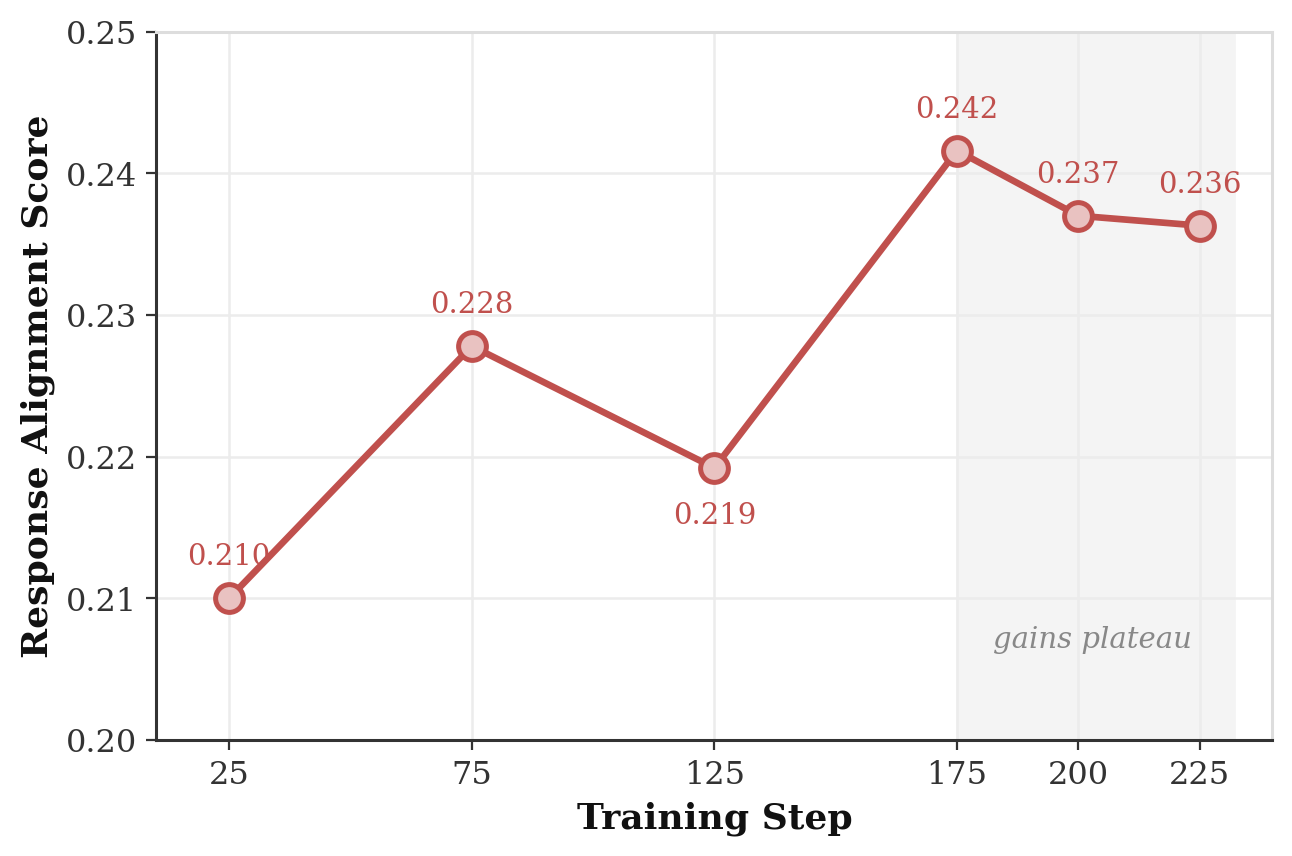
This is the HumanLM validation curve. Response alignment increases from 0.210 at step 25 to a peak of 0.242 at step 175, a relative improvement of about 15 percent. It then levels off slightly over the final checkpoints. Do the underlying state dimensions follow the same trajectory?
Different parts of a user are learned at different rates
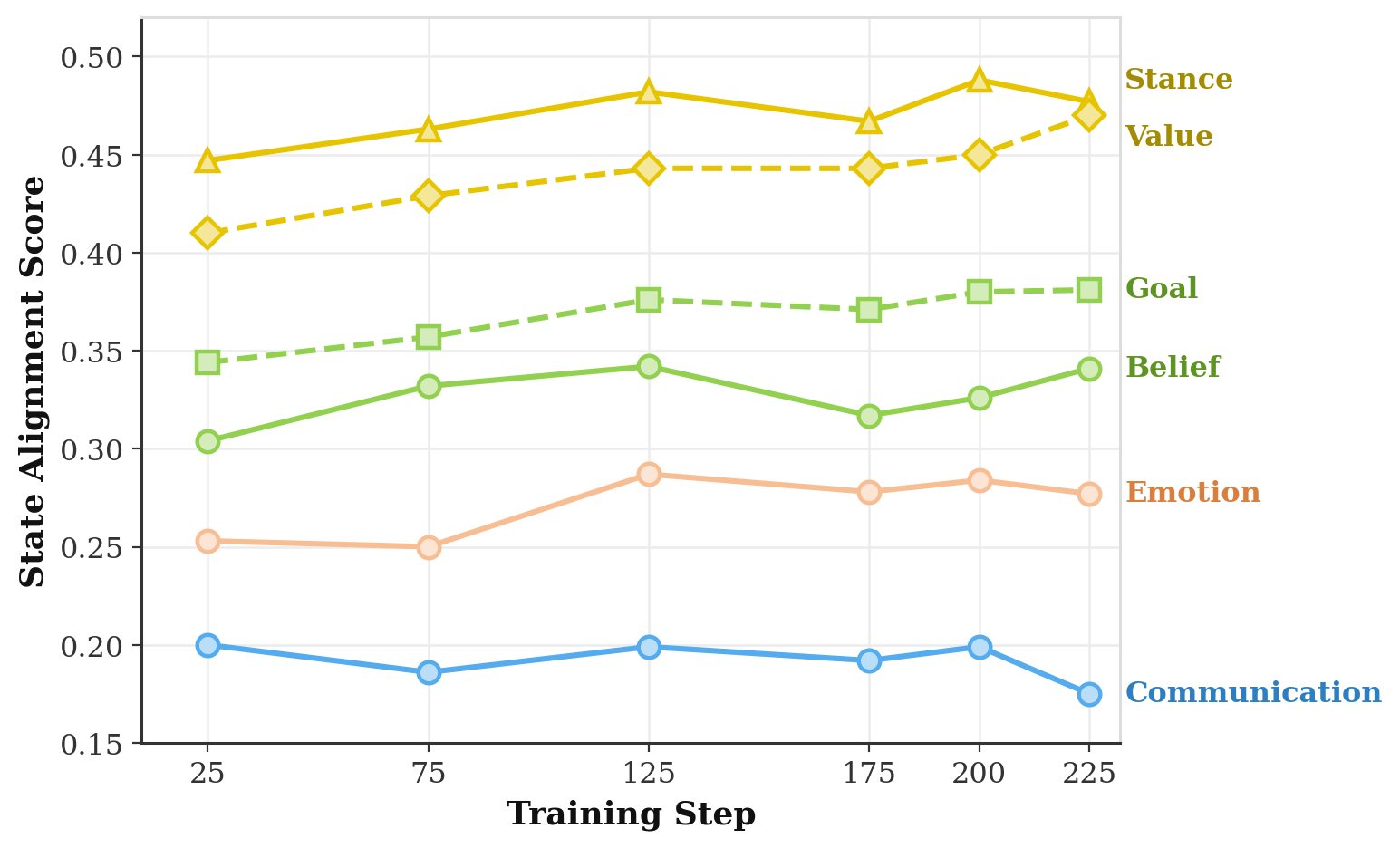
Breaking alignment down by state dimension, five of the six improve over training, but none tracks the response-level curve exactly. Value is the clearest climber (+15% relative improvement), with the rest improving more modestly.
Communication, which captures how the user structures and delivers a message, is the exception. On Humanual-Opinion, communication alignment ends slightly below where it began.
Communication still matters. In the paper, it is the third most correlated dimension with response quality, with r=0.59. Yet on Humanual-Opinion, it barely improves during training, even as stance, values, and goals improve. This suggests that the model can improve on state alignment without substantially changing how the user expresses themselves. As we see below, communication follows a different trajectory in another domain.
Watching one response evolve
Below we observe one validation example across training. In this example, the model responds to a Reddit post about someone being mocked by their cousin for struggling with chopsticks. The real user, in their response, ignores most of the family conflict and reacts to one small detail, namely lightsaber chopsticks that were mentioned in a parent comment.
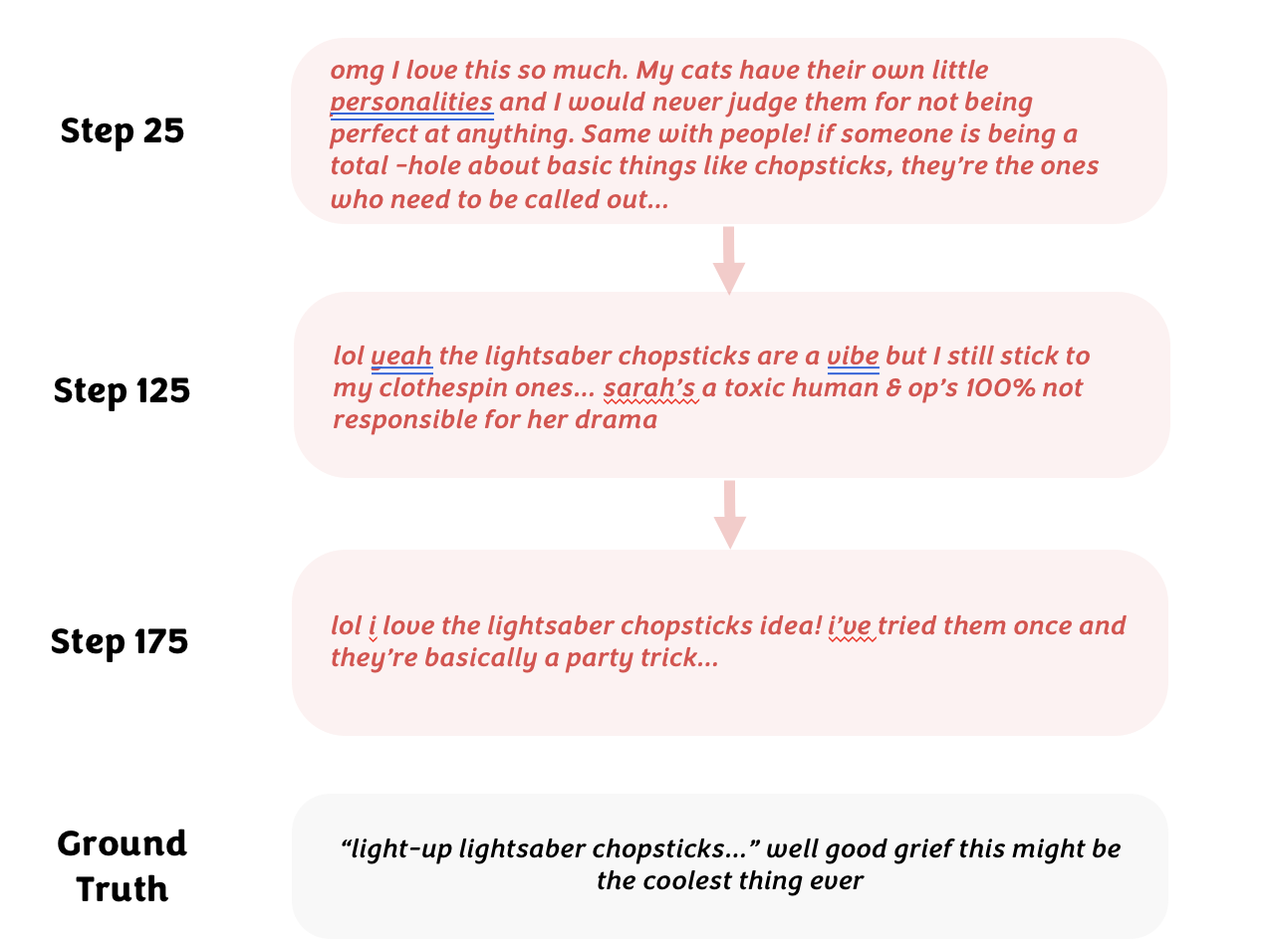
Across the checkpoints, HumanLM evolves along different state dimensions at different times.
Emotion seems to transform the most. At step 25, the response is indignation on the OP's behalf. By step 125, the model's response contains some playfulness, but it's mixed with a hostility not present in the ground truth. Only at step 175 does the response reach the correct emotion, amusement.
The goal also shifts across training, from validating OP's feelings at steps 25 and 125, to correctly reacting to a detail at step 175.
Meanwhile, the stance changes target rather than direction. Early on, the model takes a position on the family conflict; by 175, its position is about the chopsticks themselves, which is what the real user actually had an opinion on.
We can see the state dimensions converge at the right states at different times! The model finds the stance with its real target first, then the emotion sheds the indignation that the real user didn't have, and the goal narrows last.
The dynamics depend on the domain
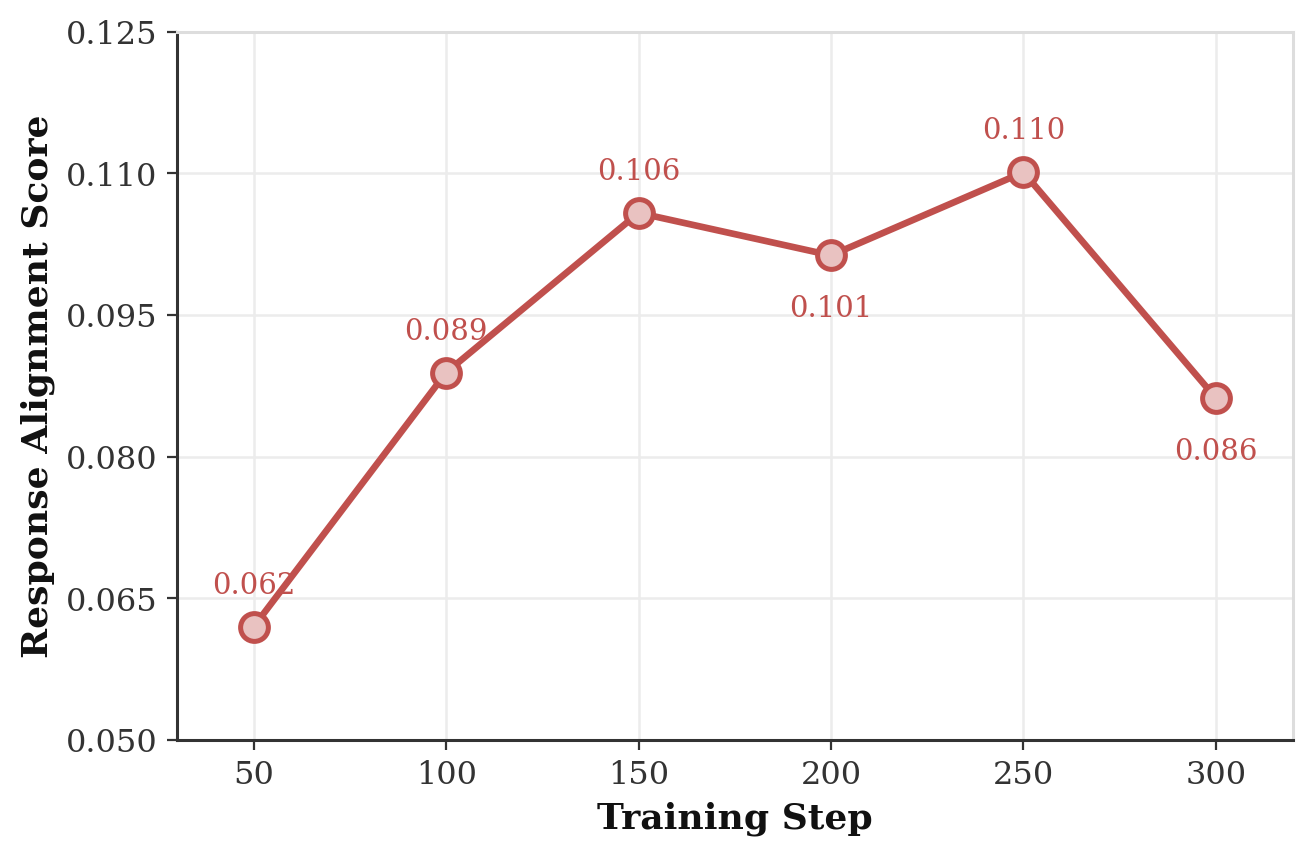
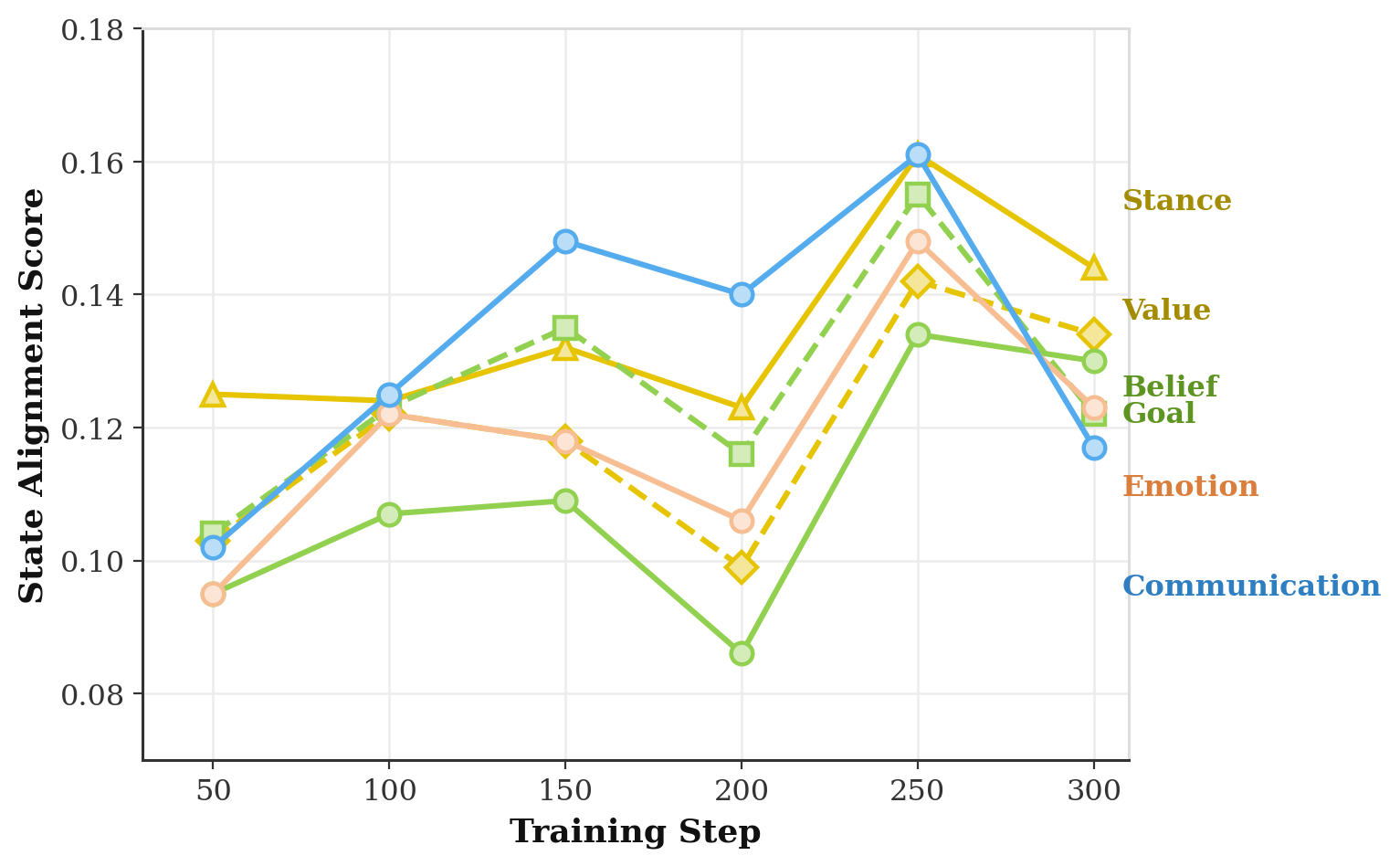
We ran the same analysis on a second training run using Humanual-News, which contains YouTube news comments. The pattern changes. The trajectories are noisier, the six dimensions move more closely together, and their scores swing from checkpoint to checkpoint.
Notably, communication improves on Humanual-News alongside the other dimensions. The same state schema reveals a different learning profile when the data changes.
Across both domains, the model's ability to reason about user states develops unevenly. Additional training does not improve every state equally. Which dimensions improve, stall, or fluctuate depends on the domain.
This is where the framework becomes useful. A new deployment can start with the same psychologically grounded core and add or replace dimensions relevant to its setting, such as engagement, purchase intent, or confidence. Training can then learn how those states appear in the new data. Checkpoint analysis reveals which dimensions are improving and which remain difficult.
Takeaway
HumanLM provides a reusable training framework for user simulation. We can define a general set of user-state dimensions, then let training learn how those states appear and interact in a particular domain. Different dimensions make the largest gains in different settings, and progress across the state space accompanies better response alignment. This gives the same framework room to adapt across domains even when the learning profile changes.